By Jennifer Kreatsoulas, PhD, C-IAYT
Eating disorders rarely exist in isolation. They are complex conditions that affect both mental and physical health. Many individuals struggling with anorexia, bulimia, binge eating disorder, ARFID, or disordered eating patterns also experience co-occurring mental health and medical conditions that can deeply impact recovery and overall wellbeing. Healing often involves addressing the nervous system, emotional wellbeing, body image, trauma responses, stress regulation, and the physical effects prolonged disordered eating can have on the body.
Given that 30 million people in the United States suffer from an eating disorder, it’s highly likely that if you’re a yoga teacher, you’ll come across students who are affected. Because physical side effects—some of which are very dangerous—are associated with eating disorders, it’s important for yoga professionals who lead asana-based classes to have a basic understanding of this illness. Even in yoga settings where asana is not the primary focus, a general knowledge may be helpful, as the quiet practice of meditation, for example, may present unique challenges for those affected by eating disorders.
What Are Eating Disorders?
Eating disorders are serious but treatable mental illnesses that can affect people of every age, sex, gender, race, ethnicity, and socioeconomic group. Eating disorders are not a choice. They are bio-psycho-social diseases, which means that genetic, biological, environmental, and social elements all play a role.
According to the Diagnostic and Statistical Manual of Mental Disorders (DSM-5), an eating disorder is a behavioral condition characterized by severe, persistent disturbance in eating behaviors and is associated with distressing emotions and thoughts, all of which can affect physical, psychological, and social function.
My personal definition is that eating disorders are ways to cope with pain, and the behaviors and thoughts that perpetuate them severely sever one’s relationship with their body, to the extent that the body feels like an unsafe place that needs to be changed, tamed, and solved. Eating disorders are themselves a trauma.
It’s important to understand that, for example, anorexia doesn’t always mean skinny or emaciated, just as binge eating disorder does not always mean overweight. One’s type of eating disorder is not predicated on their body size and shape. All types of eating disorders can “look” all kinds of ways, which means you can’t always tell by one’s weight if they are suffering or not.
Common Comorbidities and Complications
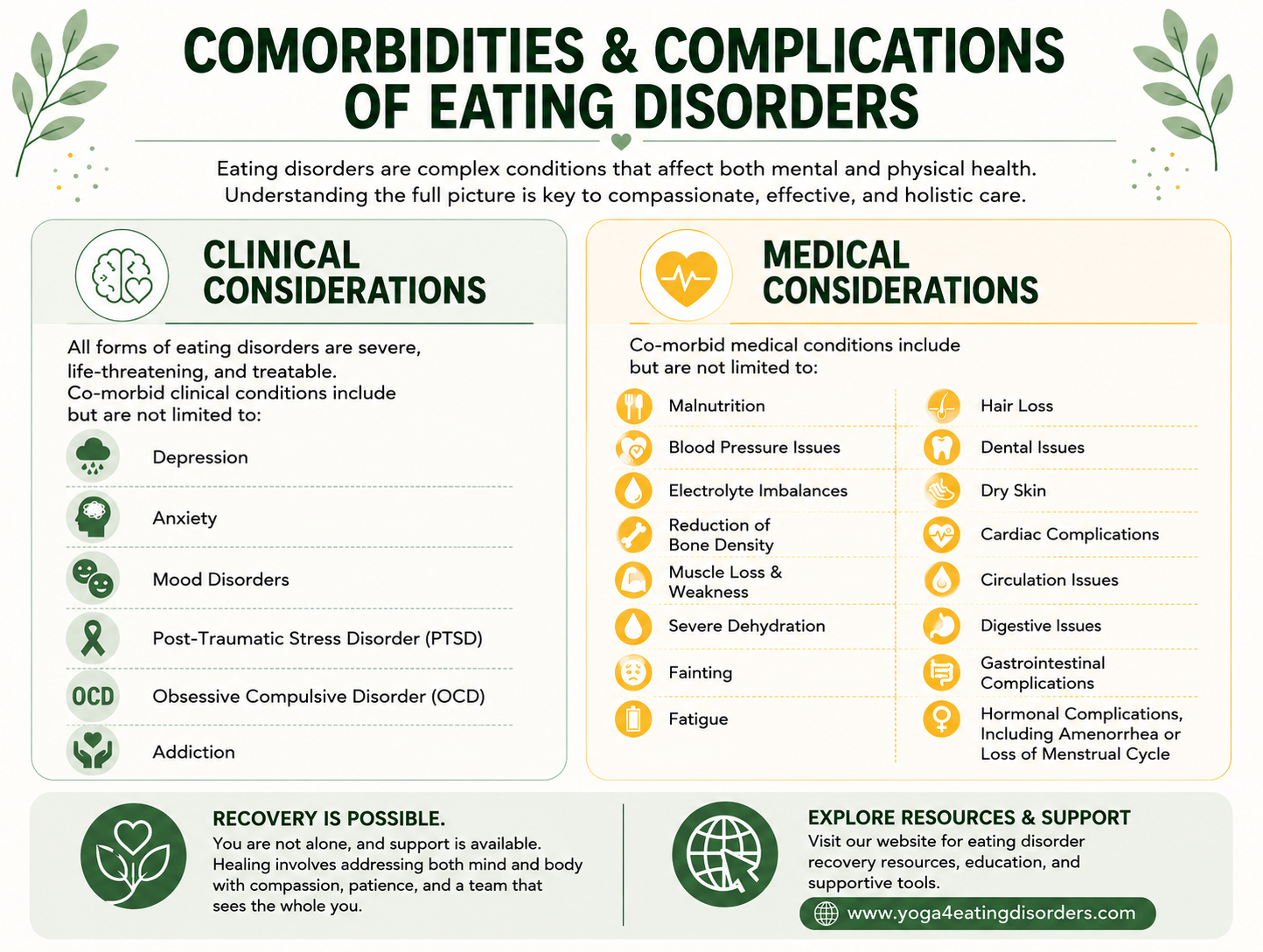
There are many medical and clinical/mental health comorbidities associated with eating disorders. Some clinical/mental health conditions include but are not limited to:
Anxiety disorders
Depression
PTSD and unresolved trauma
OCD and intrusive thought patterns
Addiction and substance abuse
Mood disorders
Some medical conditions include but are not limited to:
Malnutrition
Blood pressure issues
Electrolyte imbalances
Hormonal imbalances
Muscle loss and weakness
Severe dehydration
Digestive complications
Cardiac complications
Gastrointestinal complications
Nervous system dysregulation
Bone density loss
Fainting and chronic fatigue
Hair loss
Dental issues
Insomnia
What Yoga Professionals Need to Know
Here are eight truths about eating disorders I believe are important for yoga professionals to know. In no way am I suggesting that you are expected to diagnose or treat an eating disorder, or even interact with your students with eating disorders differently. Rather, my hope is that you’ll read this article and file it for reference; this information is for your awareness as a yoga teacher and the yoga community as a whole.
Eating disorders are serious, but treatable, mental and physical illnesses that can affect people of all body sizes, races, genders, socioeconomic statuses, sexual orientations, abilities, and ages. They may be caused by a range of biological, psychological, and sociocultural factors.
There are several types of eating disorders, the most common being anorexia nervosa, bulimia nervosa, and binge eating disorder (BED). Other types include other specified feeding or eating disorder, orthorexia, avoidant restrictive food intake disorder, pica, and rumination disorder. Symptoms associated with these disorders are ultimately ways of coping with trauma and other painful feelings and life events.
The feeling of taking up space can be extremely uncomfortable for individuals affected by eating disorders, because so much of the disorder is about shrinking physically, mentally, and/or emotionally. Big poses like warriors and other upright, expansive positions can bring on feelings of vulnerability and fear. With practice and time in a supportive environment, these types of poses can be quite healing, connecting individuals to the virtues of strength and confidence, for example.
Individuals with eating disorders may also be uncomfortable taking deep breaths, for fear of feeling their bodies expand. (As a result, these students often breathe from their chests.) With time and practice, breathing can become more comfortable and even life-changing, offering individuals a new sense of internal safety and a calming effect.
Individuals affected by eating disorders are prone to severely negative body image and body dysmorphia, which can make yoga class extremely challenging, especially in settings with mirrors. Body comparing and a preoccupation with how one’s body looks or performs can make it difficult to stay present. Yoga can be helpful in teaching these students tools for practicing presence on and off the mat.
Medical complications include blood pressure issues, electrolyte imbalances, reduction of bone density, muscles loss and weakness, severe dehydration, fainting, fatigue, hair loss, dental issues, hair loss, dry skin, digestive problems, circulation problems, and hormonal imbalances.
Exercise addiction can be a component of an eating disorder, and yoga can sometimes be used to that end.
Recovery from an eating disorder is a long-term process that typically requires therapeutic support and often treatment. Yoga can be instrumental in this process, offering practitioners embodied experiences that, over time, contribute to mending the severed relationship with one’s body and self-esteem.
Yoga Has a Place in Treatment for Eating Disorders and Comorbidities
Eating disorders rarely exist in isolation. Many individuals struggling with anorexia, bulimia, binge eating disorder, ARFID, or disordered eating patterns also experience co-occurring mental health and medical conditions that can deeply impact recovery and overall wellbeing. This is why eating disorder recovery requires compassionate, multidisciplinary care that supports both the mind and body — not just symptoms around food.
Yoga can serve as a supportive, trauma-informed complement to recovery by helping individuals reconnect with their bodies safely through mindful movement, grounding, breathwork, and self-awareness practices. Yoga has the powerful potential to support healing of all kinds in students, and yoga teachers have the special opportunity to guide movement and embodied experiences that encourage this transformation. The greater our awareness of possible life experiences of students, the greater our ability to teach from a place of compassion and sensitivity. An eating disorder is one such life experience, and yoga holds the possibility of such tremendous healing for those affected.
If you are a yoga teacher and wish to learn more about teaching from an eating disorder-informed lens, get in touch to explore mentoring opportunities with me.